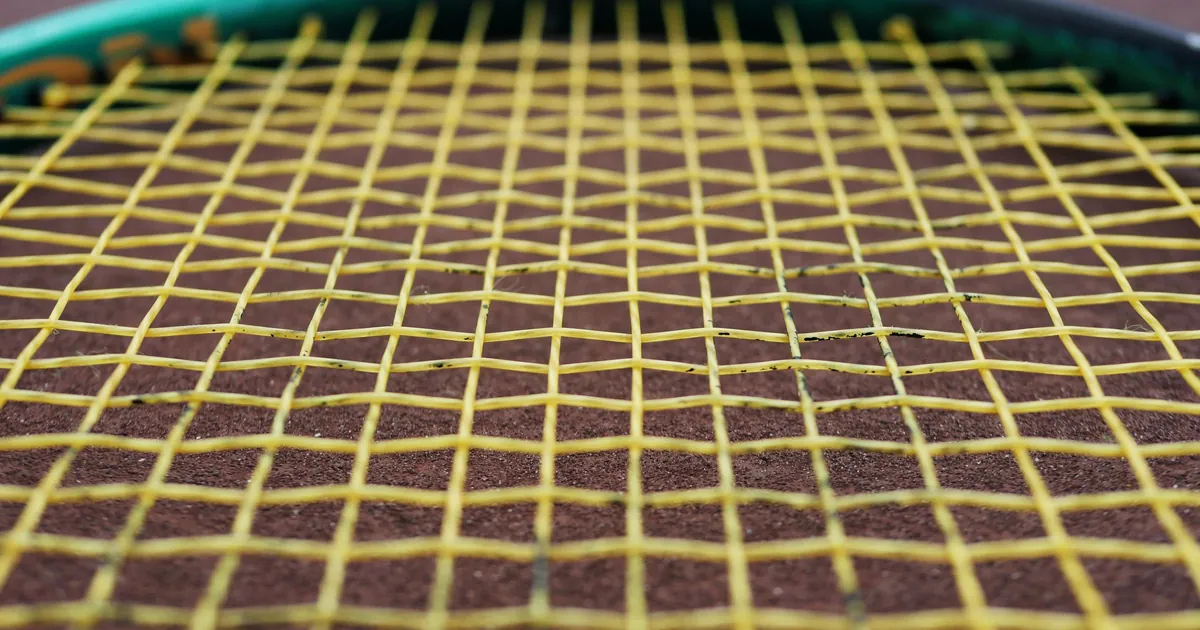
Ask around about string patterns and you'll get the same two-line answer every time: 16×19 for spin, 18×20 for control. It isn't wrong. It's just a shortcut that hides the parameter doing the actual work — density, meaning the space between the strings. And between those two familiar numbers sits an entire spectrum, from ultra-open grids built for spin to tightly packed beds cut for precision.
String pattern is one of the most influential specs on a racquet and one of the least understood, largely because it gets reduced to a cliché before anyone explains the mechanism. This guide walks through what the numbers actually describe, what changes on court when the squares get bigger or smaller, and how to read a pattern in the context of the frame it belongs to.
1. Spacing Comes Before the Numbers
A string pattern describes how many mains (the vertical strings, running from the throat to the tip) and how many crosses (the horizontal strings) make up the string bed. It's always written mains × crosses: a 16×19 has 16 mains and 19 crosses. The important part is that this is a property of the frame, not of the stringing. The grommet holes are drilled at the factory, exactly like head size, and no stringer can change them.
Here's where the shorthand breaks down. The open/dense distinction isn't really about the count — it's about the size of the squares those strings form. Fewer strings, or strings spread further apart, means bigger gaps. And an identical pattern won't have identical density from one racquet to the next: a 16×19 in a 100 in² head is more open than the same 16×19 in a 95 in² head, because the same number of strings has to cover more surface. Grommet placement moves the picture again, since manufacturers can bunch strings toward the centre and spread them at the edges, or the reverse.
🎾 Expert insight
Two racquets can share a pattern on paper and play nothing alike, depending on head size and how the grommets are distributed. When you're comparing frames, look at the spacing in the string bed — not just at the two numbers in the spec table. You can check head size alongside the pattern for every frame in our racquet database.
2. The Full Spectrum of String Patterns
Most conversations stop at two options. In practice, current frames cover a much wider range, and the intermediate patterns are where a lot of the modern market lives.
| Pattern | Type | Profile in brief |
|---|---|---|
| 16×15 / 18×16 | Ultra-open | Extreme spin and a soft, forgiving feel — but strings break fast and control drops off. |
| 16×18 | Very open | Huge spin and power, with weaker tension maintenance over the life of the string job. |
| 16×19 | Open (the standard) | Spin, power, a high launch angle, and a string bed that stays easy on the arm. |
| 16×20 | Intermediate | Sits between bite and control, with a denser core to the string bed. |
| 18×19 | Intermediate | Essentially a tightened 16×19 — but one fewer cross reopens the spacing. |
| 18×20 | Dense (control) | Control, precision, durability, and a flatter, lower trajectory. |
Read that table as a gradient rather than as six separate categories. Moving one step down it is a smaller change than moving from one end to the other, and the intermediate patterns exist precisely because most players don't want either extreme.
3. What Density Actually Changes
| Criterion | Open pattern | Dense pattern |
|---|---|---|
| Spin | + | – |
| Power | + | – |
| Launch angle | High | Low |
| Control / consistency | – | + |
| Durability | – | + |
| Comfort | + | – |
Why an open pattern spins the ball
An open bed lets the mains slide sideways on contact and snap back into place before the ball leaves the strings. That snapback is what brushes rotation onto the ball, and it's the reason wider spacing reads as more spin. The same looseness produces a trampoline effect: the bed deforms further and gives more of that energy back, which is free power. The by-product is a higher launch angle — the ball leaves the racquet on a steeper trajectory, which is exactly what a heavy topspin player wants and exactly what frustrates someone trying to hit through the court flat.
Why a dense pattern controls it
Pack the strings closer together and the bed stops moving as much. Less deformation means less unpredictability: the ball comes off flatter, shot after shot, and the racquet rewards a player who already generates their own pace. Durability improves for the same reason — strings that don't saw across each other on every ball simply last longer. The trade is comfort. A stiffer, less mobile bed transmits more of the impact into the hand, wrist and elbow, which matters if your arm has ever complained.
⚙️ Pattern + gauge: the pairing that decides everything
Pattern and gauge work together, and one can partly cancel the other. A thick string in an open pattern effectively closes the gaps back up; a thin gauge in a dense pattern reopens the bed. If you like a frame but not its natural behaviour, gauge is your first correction — and tension, in pounds (or kilos), is the fine adjustment on top.
This is also the honest limit of the shortcut everyone repeats. Pattern sets the baseline behaviour of the frame; string type, gauge and tension decide where inside that range you land. It's the reason two players with identical racquets can describe completely different feels, and the reason changing string setup is a far cheaper experiment than changing racquets. If you want to see how those three dials interact before you spend anything, run the combination through our string configurator, which scores the firmness of a full setup — frame, string and tension together — rather than judging any one of them in isolation.
4. Four Champions, Four Densities
The most useful argument against any "best pattern" claim is the top of the men's game, where four players with four different densities have all won at the highest level:
- Rafael Nadal — 16×19 (Pure Aero). Pure open, in the service of devastating topspin.
- Carlos Alcaraz — 16×20 (Pure Aero 98). The spin/control compromise.
- Novak Djokovic — 18×19 (custom frame). Control first, with one fewer cross to claw back some spin.
- Alexander Zverev — 18×20. Dense and unapologetic, chosen for precision.
Note what these four setups have in common: nothing, other than being matched to the player's game. Copying a pro's pattern without their swing speed, technique and physical conditioning is one of the most reliable ways to end up with a racquet that fights you.
5. Which Pattern Is Right for You?
- Heavy topspin, aggressive game: open pattern — 16×19, or 16×18 if you want the extreme.
- Flat hitter who wants control and durability: dense pattern — 18×20.
- All-court, no dominant tendency: 16×19 as the default; 16×20 or 18×19 if you want the compromise.
- Sensitive arm: a more open pattern, a softer string and a moderate tension.
One practical note on that last line. Arm comfort is the case where the pattern decision is worth taking seriously rather than treating as a preference, because a dense bed strung with a stiff string is one of the harsher combinations available. It's also the case where the string setup can rescue a frame you otherwise like: a softer string at a lower tension in an 18×20 will feel very different from a stiff polyester cranked tight in the same racquet.
Need a precise setting rather than a rule of thumb?
Cross-reference pattern, gauge and tension to estimate the firmness you'll actually feel, and see whether your combination flags an arm-comfort risk.
⚙️ Open the configurator🎯 Conclusion
String pattern is the structural foundation of your setup — the one decision you make when you buy the frame and can never revisit afterwards. The variable that matters isn't the choice between two numbers, it's density: how much room the strings have to move. Open buys you spin, power and comfort. Dense buys you control and durability. Everything after that — string type, gauge, tension — is how you fine-tune the frame you've already committed to.
So pick the pattern that matches how you actually play, not how you'd like to play on your best day. Then spend your attention on the string setup, where adjustments are cheap, reversible, and where most of the feel you're chasing genuinely lives.