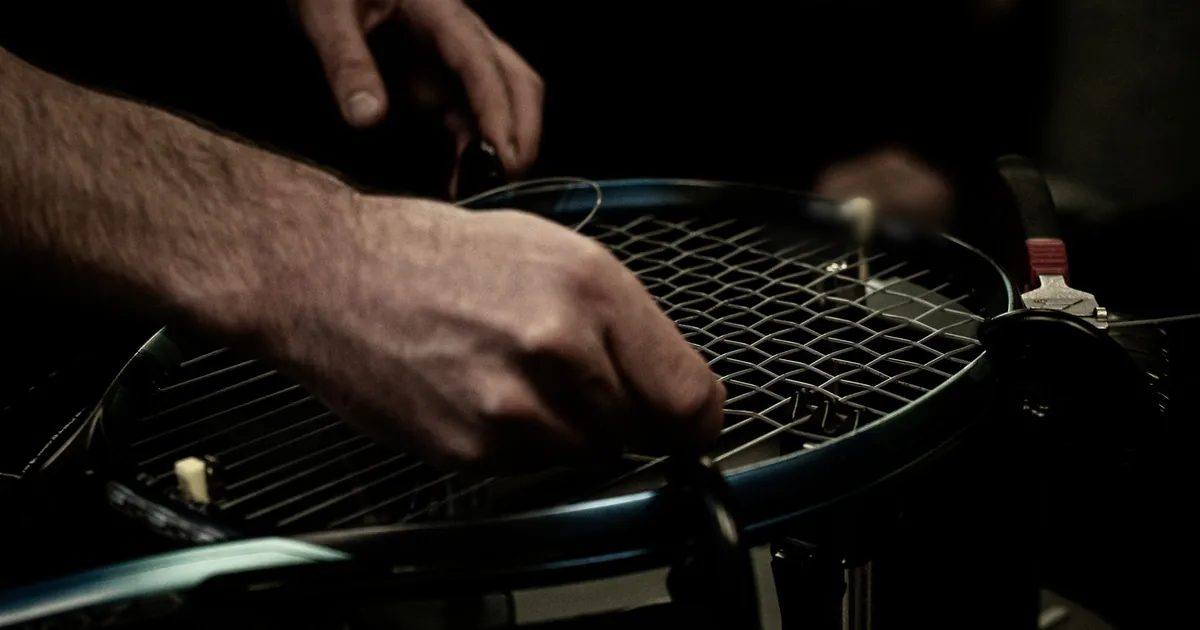
How many times have you handed your racquet over the counter and said "the usual" without knowing what that number does to your game? String tension is the most neglected setting in club tennis — and one of the fastest ways to change how a racquet feels, with no new frame and no new technique.
Research collected by Tennis Warehouse University shows that the dynamic stiffness of a string bed — which tension directly drives — governs power, comfort, control and even spin potential. And the relationship is not the one most players assume. It is not linear, and on the power question it runs backwards.
This guide walks through the physics, the tension loss nobody warns you about, what ATP and WTA players actually string at, how to adjust for heat, cold and surface, and a starting range by player profile. Every number is given in pounds first, with the kilogram equivalent in brackets.
📐 First, the units: pounds and kilos
Stringing machines in the US, UK and most of the English-speaking world are calibrated in pounds. Much of the technical literature — and most European stringers — work in kilograms. One kilogram equals 2.2046 lb, so a 1 kg change is a shade over 2 lb, and a 2 kg change is roughly 4.5 lb. Keep this table nearby; every recommendation below uses it.
| Kilograms | Exact (lb) | Used here (lb) | Typical label |
|---|---|---|---|
| 18 kg | 39.7 | 40 lb | Very low |
| 19 kg | 41.9 | 42 lb | Very low |
| 20 kg | 44.1 | 44 lb | Low |
| 21 kg | 46.3 | 46 lb | Low |
| 22 kg | 48.5 | 48 lb | Low |
| 23 kg | 50.7 | 51 lb | Medium |
| 24 kg | 52.9 | 53 lb | Medium |
| 25 kg | 55.1 | 55 lb | Medium |
| 26 kg | 57.3 | 57 lb | High |
| 27 kg | 59.5 | 60 lb | High |
| 28 kg | 61.7 | 62 lb | Very high |
Rounded to the nearest pound. Most machines are set in whole or half pounds, so a half-pound of rounding is well inside the tolerance of the job itself.
⚗️ 1. The physics of tension
1.1 The tension–power paradox
Here is the most persistent myth in tennis: tighter strings hit harder. They do not. Tennis Warehouse University's research demonstrates the exact opposite.
The mechanism is straightforward. A looser string bed deforms more on impact, producing a more pronounced trampoline effect. According to TWU, a softer bed absorbs less energy into deforming the ball and returns more of it — which shows up as more perceived power and a softer feel. Tighten the strings and you flatten the ball more, and a flattened ball wastes energy as heat.
EXPERT NOTE
All strings return roughly 95% of the energy fed into them. The "power" difference between string beds comes from how much energy is absorbed by the strings versus the ball. A softer bed absorbs more, so the ball loses less — hence the higher exit speed.
What tension actually changes
| Parameter | Low tension (below ~48 lb / 22 kg) | High tension (above ~55 lb / 25 kg) |
|---|---|---|
| Power | ↑ More power | ↓ Less power |
| Control | ↓ Less control | ↑ More control |
| Comfort | ↑ More comfort | ↓ Less comfort |
| Dwell time | ↑ Longer (4–7 ms) | ↓ Shorter |
| Sweet spot | ↑ Larger | ↓ Smaller |
Source: Tennis Warehouse University — String Stiffness Database.
1.2 Tension and spin: the snapback effect
Spin is where the internet gets loudest and least accurate. Tension alone does not set your spin ceiling — the string type matters more than the number on the machine.
With polyester, lower tension favours snapback: the main strings slide sideways on impact, then snap back into place, brushing the back of the ball upward. That mechanism adds topspin.
- Low tension + poly: more string movement, more snapback, more spin potential.
- High tension + poly: less movement, flatter trajectory, more control.
- Multifilament or natural gut: snapback is minimal — tension mostly moves power and comfort, not spin.
REALITY CHECK
Roughly 90% of spin comes from your swing. Strings only optimise what your technique already produces. No "spin-friendly" setup will rescue a flat stroke.
📉 2. Tension loss: a fight you cannot win
A fresh string job starts losing tension immediately — before you hit a single ball. TWU measurements show strings can shed up to 15 lb within a minute of being tensioned, then another 20 lb over the first hits. That is why tour players have racquets strung the night before or the morning of a match: they want a bed that has already stabilised and behaves predictably.
| String type | Tension loss in the first 24 hours |
|---|---|
| Natural gut | 5–10% |
| Multifilament | 10–15% |
| Synthetic gut | 15–18% |
| Polyester | 20–25% |
Sources: Tennis Warehouse University, Human Kinetics, The Racquet Man.
EXPERT NOTE
What matters is not the reference tension — it is the stiffness of the bed after it stabilises. Two different strings pulled at the same number can feel nothing alike once settled. This is why pre-stretching matters, and why "I string at 55" tells you far less than players think.
🏆 3. What the pros string at
The clearest trend on tour over recent years is tensions coming down. Tennisnerd reports that averages have fallen from the 53–57 lb band (24–26 kg) into the mid-40s in pounds (20–22 kg) for a large part of the field.
| Player | String | Tension | Band |
|---|---|---|---|
| Jannik Sinner | HEAD Hawk Touch | 62 lb (28 kg) | High |
| Carlos Alcaraz | Babolat RPM Blast | ~55 lb (~25 kg) | Medium |
| Novak Djokovic | VS Gut + ALU Power Rough | 59/56 lb mains/crosses (26–28 kg) | High |
| Lorenzo Sonego | ALU Power Soft | 42 lb (19 kg) | Very low |
| Andrey Rublev | Lynx Tour | 57/55 lb mains/crosses (26/25 kg) | Medium |
| Daniel Evans | ALU Power + Gut | 48 lb (22 kg) | Low |
Sources: Tennisnerd — ATP Player Strings, Houston 2025; Mouratoglou Academy.
The exceptions are as instructive as the trend. Sinner and Stan Wawrinka hold the top of the range at 58–62 lb with a full poly bed, while Sonego goes down to 42 lb (19 kg) — a 20 lb spread among players at the same level of the sport. Each of them fits the tension to their game, not their game to a number. That is the whole lesson, and it applies just as much at club level.
EXPERT NOTE
Roger Federer often carried racquets at two different tensions — 57 lb (26 kg) and 60 lb (27 kg) — to adapt to conditions. Facing a big server, he reached for the tighter one: not for power, but for control on the return.
🌡️ 4. Adjusting for conditions
4.1 Temperature
TWU's work on temperature confirms what players feel intuitively:
- Hot weather: strings become more elastic and lose tension faster — string 2–3 lb tighter to keep control.
- Cold weather: strings stiffen and lose elasticity — string 2–3 lb looser to preserve comfort and power.
- The car trunk problem: leaving a racquet in a hot boot causes significant tension loss. TWU showed that heat exposure after stringing is more damaging than heat before it.
4.2 Surface
- Clay: slower play, heavier balls — drop 2–4 lb (1–2 kg) to gain depth and make topspin easier to generate.
- Indoor and fast courts: quicker play, livelier balls — add 2–4 lb (1–2 kg) for control.
- Grass: low, fast bounces — slightly higher tension helps control flat trajectories.
🎯 5. Starting ranges by player profile
| Profile | Polyester | Multifilament / Gut | Hybrid |
|---|---|---|---|
| Beginner | Not recommended | 48–53 lb (22–24 kg) | 48–53 lb (22–24 kg) |
| Intermediate | 44–51 lb (20–23 kg) | 53–57 lb (24–26 kg) | 48–55 lb (22–25 kg) |
| Advanced / competitive | 40–55 lb (18–25 kg) | 55–62 lb (25–28 kg) | 51–60 lb (23–27 kg) |
| Senior / sensitive arm | 40–46 lb (18–21 kg), soft poly only | 48–55 lb (22–25 kg) ✓ | 46–53 lb (21–24 kg) ✓ |
| Big hitter | 48–57 lb (22–26 kg) | 57–62 lb (26–28 kg) | 53–60 lb (24–27 kg) |
These are starting points, not prescriptions. Personal experimentation stays essential.
ARM HEALTH COMES FIRST
Comfort falls as tension rises, and polyester is the stiffest family of strings on the market — which is exactly why it is not recommended for beginners at any tension, and why the sensitive-arm profile above sits at the bottom of the poly range with a soft poly, or moves to multifilament altogether. If your elbow, wrist or shoulder is talking to you, treat that as the constraint and pick the tension inside it. Never chase control by tightening a stiff poly bed on an arm that already hurts. Our RCS calculator exists for exactly this: it rates how firm a given racquet, string and tension combination is, so you can see whether a setup is a comfort risk before you pay for it.
Not sure which profile is yours?
Our configurator reads your racquet, your level and your arm sensitivity, then returns a tension in pounds along with the strings that suit it. You can also browse the full string catalogue if you already know what you are looking for.
Find my ideal tension →✅ Your action plan
Tension is not a technical detail reserved for tour players. It is a live control on how your racquet plays, and you can move it for the price of a string job. Here is how to use it deliberately:
- Identify your profile — beginner, intermediate, advanced, sensitive arm — and note the pound range above.
- Move in small steps: 2–4 lb (1–2 kg) up or down from your current tension, never more in one go.
- Judge over two or three sessions, not one. Rate power, control and comfort separately before you conclude.
- Adapt to conditions: temperature, surface and ball type all shift the right answer.
- Restring on schedule. A dead string bed no longer plays at any tension, whatever the number you asked for.
There is no correct tension in the abstract. There is only the tension that suits you, your stroke and your frame — and finding it is a couple of string jobs away.