⚡ The short version
- Dead strings are two failures at once. Perpendicular stiffness drops (the ball sails) while string-on-string friction rises (less spin, a harsher bed). Tennis Warehouse University showed both in 2013.
- What you feel is the net of the two. That's why one player calls a worn string "mushy" and the next calls the same string "a board."
- Strings lose tension sitting in the bag. A racquet that sat out the winter is no longer at the tension on the stencil.
- No hour count has ever been measured. TWU counts bench impacts. The "2 to 20 hours" you see quoted is how players describe it, not a measurement.
- "Restring as many times a year as you play per week" is a convention: a sensible floor that knows nothing about your string.
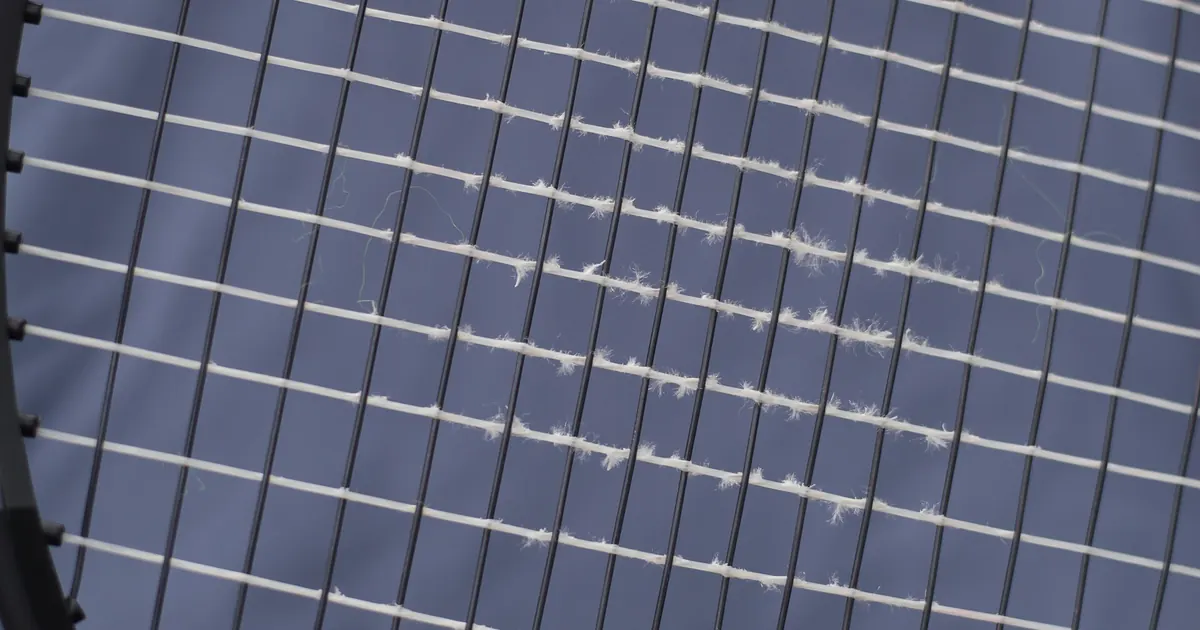
Everyone has said "my strings are dead," and hardly anyone means the same thing. For one player, balls are flying long and the bed feels like a trampoline. For another, the bed has turned into a plank that stings the arm and won't spin the ball anymore. Both are right.
Most restringing advice answers in hours or weeks and cites nothing. This article starts instead from the only published experiments we could read end to end, from Tennis Warehouse University (TWU), the testing lab of the US retailer, and is explicit at every step about what they measured and what they didn't. You won't leave with an hour count. You'll leave knowing which failure you have and what to do about it.
📑 In this article
- ⚖️ The verdict: dead strings are two failures that contradict each other
- 📉 Failure 1: perpendicular stiffness drops
- 🧲 Failure 2: string-on-string friction rises
- 🩺 Symptom → cause → action
- 🧳 Tension loss at rest, and the off-season trap
- ⏱️ Why nobody can give you an hour count
- 📏 The restringing rule: a convention, labelled as one
- ❓ FAQ
⚖️ 1. The verdict: dead strings are two failures that contradict each other
In March 2013, Crawford Lindsey published How Tennis Strings "Go Dead" on the TWU site. It opens with a list of player complaints, quoted verbatim: "The strings lose power." "The strings hurt my arm." "It hits like a board." "The ball just takes off." "The strings trampoline the ball." "I can't hit with as much spin."
Those complaints contradict each other, sometimes about the very same string. Rather than pick a side, Lindsey went looking for what physically changes in the string. His answer: string death comes mainly from a drop in perpendicular stiffness and a rise in static and sliding friction between mains and crosses. The first makes the bed livelier and harder to control; the second makes it harsher and stingier with spin. Whenever one factor pushes a performance variable up, he writes, another shows up to push it down. It's the net effect that decides what the player perceives.
What TWU tested, and how
- Pendulum rig on a single string. Sixteen strings (eleven polyesters, five nylons) tensioned at 62 lb (about 28 kg) and struck by a pendulum hammer weighted to load one string the way a 120-140 mph serve would. Between 800 and 9,000 impacts depending on the string.
- Strung racquet and kettlebell. A Wilson Pro Staff Six.One 100 and a Wilson Steam strung with polyester at 52 lb (about 23.6 kg), hit by a 20 lb kettlebell dropped from about 10 inches, up to 5,800 times. Between sets, balls fired from a machine measured rebound speed, spin and angle.
- Friction rigs. Static and sliding coefficients of friction between strings, after repeated sliding under pressure.
Two limits frame everything that follows: string ageing is counted in bench impacts, never in hours of play, and the measurements date from 2013.
📉 2. Failure 1: perpendicular stiffness drops, and the ball stays on the strings longer
A string has two kinds of stiffness. Longitudinal stiffness, the number on spec sheets, is how hard it is to stretch. Perpendicular stiffness is how hard it is to push sideways, which is what the ball does at impact. Per TWU, the second is always far lower than the first: 20-35 lb/in versus 130-300 lb/in. And it's the one the player and the ball actually feel.
Perpendicular stiffness depends mostly on tension, and tension bleeds away. TWU writes that every string starts losing tension the second it goes into the racquet, up to 15 lb in one minute, and as much as 20 lb in 20 hits on its test machine. Polyester loses more than nylon, which loses more than gut. After that the loss slows but never stops: after a 100-hit break-in, the strings in the study were spread about 30 lb apart, even though every one of them had been pulled at 62.
As perpendicular stiffness falls, the bed pockets the ball deeper. On the rig, dwell time "starts increasing at ever faster rates" as perpendicular stiffness declines. Lindsey's reading: the ball rides the strings through more of the swing arc and leaves higher or wider. It sails, and control goes. One counter-intuitive finding: the polyesters, stiffer lengthwise than the nylons at every tension, had the same or lower perpendicular stiffness. Harder to stretch, easier to deflect.
💡 What the study does not show
On the free-hanging racquet hit by the kettlebell, TWU measured very little change in rebound. With Solinco Tour Bite, outgoing spin went from 1,757 rpm on the first impact to 1,719 after 5,800 drops, and the angle from 37.7° to 37.1°. Lindsey's explanation is that a hanging racquet barely rotates during impact, whereas a swinging racquet sweeps enough angle for the extra dwell time to change the trajectory. That's an argument, not an on-court measurement. Failure 1 is measured on a single string and only plausible in real play.
🧲 3. Failure 2: friction rises, and the mains stop snapping back
A polyester's spin comes from the mains sliding sideways across the crosses at impact and then snapping back. That sliding has a second job people tend to forget: it softens the impact in the plane of the stringbed.
What lets the mains slide is low friction between strings. TWU tracked both coefficients over repeated cycles: static friction, which resists the start of a slide, and sliding friction, which drags on it once it's going. Both tend to rise with wear, and not at the same rate for every string. TWU sees in that spread the reason some strings "die" sooner than others, which is exactly what players report.
The consequences mirror failure 1: less sliding, so less spin, a lower launch angle and a bed that's stiffer in its own plane. Players perceive it, Lindsey writes, as a loss of power and spin and an increase in stiffness, harshness and pain, especially if they start swinging even faster to compensate.
That last line matters if your arm is sensitive. A bed that's gone harsh is not an invitation to swing harder. That's precisely the reaction that makes it worse. If your elbow already hurts, see a doctor first; on the equipment side, our tennis elbow string guide covers what a string can and can't do, and the configurator flags setups above the elbow-risk threshold.
Three caveats the study states itself
- Not a straight line for every string. For a few strings, static friction drops first before it climbs.
- Noisy data. TWU calls its friction curves "more chaotic" than the others; its rigs were built for out-of-the-package strings.
- An open anomaly. A couple of nylons were among the lowest-friction strings, which runs against the usual picture. TWU offers two hypotheses and says notching tests remain to be done.
🩺 4. Symptom → cause → action
The "cause" column follows the mechanisms TWU describes. The "action" column has no numbers in it, because no source supports one.
| What you notice | Likely cause | What to do |
|---|---|---|
| Balls flying long or wide with no change in your stroke; trampoline feel | Failure 1: lower tension and perpendicular stiffness, longer dwell time | Restring. Don't fix it by braking your swing: the bed changed, not you. |
| Mushy bed, control slipping away | Failure 1 | Restring, and check that the tension you ask for suits your setup. |
| Less spin than before | Failure 2: higher friction, mains sliding and snapping back less | Restring. TWU describes no adjustment that gives the strings their slide back. |
| Mains staying out of place after shots | Failure 2: friction holding the strings | Restring. |
| Harsh, boardy bed; impacts feel harder | Failure 2: the sliding that cushioned impact is gone | Restring, and don't compensate by swinging harder. Sensitive arm: check your setup's firmness index. |
| Elbow or wrist pain that showed up with worn strings | Possibly failure 2, but pain has other causes | Medical advice first. Then review the setup in the configurator. |
| Everything feels off after a long break | Tension lost at rest (next section) | Restring before you judge your game. |
Breakage isn't in the table. A string can be dead in both senses long before it snaps, polyester especially, since it's so durable mechanically. And if your symptoms are mixed, that's what the study predicts. You don't need to decide which failure dominates: both point to the same fix.
🧳 5. Tension loss at rest, and the off-season trap
Strings don't only age when you play. TWU writes that the tension of any string changes "with every second of passing time and with every hit." The loss is fastest right after stringing, over the following hours and on the very first hits; after that it settles to a near-indiscernible rate, "but a rate that adds up to considerable loss over a lot of time."
Tecnifibre describes the same thing and calls it the static effect: the string "tires and loses tension... all by itself, over time." The brand notes that many players at pro tournaments ask for their racquets to be strung the morning of the match, so they don't lose tension overnight. And it spells out the off-season trap: when you open your bag in April after a winter without playing, your strings are naturally loose, and you should restring them.
⚠️ The off-season trap
Coming back stacks three unknowns: rusty strokes, less fitness, and a bed that has drifted off its tension. Players blame the flying balls on rust. Some of it may be the strings, and that's the only one of the three you can fix in an hour at the stringer. Tecnifibre adds that an excessively low tension is more dangerous for the muscles. We found no measurement behind that sentence, and a string maker has an obvious interest in you restringing. Read it as a manufacturer's opinion, not an established fact.
Not every string drops at the same rate
TWU's string database lists a tension-loss percentage for each string it has tested. Here are a few common ones, read on October 1, 2026, at the database's reference conditions: 51 lb, "Fast" swing speed.
| String (gauge tested by TWU) | Material per TWU | TWU tension loss |
|---|---|---|
| Babolat VS Touch 15L (1.35) | Gut | 12.4% |
| Tecnifibre X-One Biphase 17 (1.24) | Nylon/Polyurethane | 15.1% |
| Wilson NXT 16 (1.30) | Nylon | 20.5% |
| Luxilon 4G 16L (1.25) | Polyester | 21.3% |
| Head Lynx Tour 17 (1.25) | Polyester | 24.6% |
| Solinco Hyper-G 16L (1.25) | Polyester | 24.7% |
| Babolat RPM Blast 17 (1.25) | Polyester | 33.3% |
| Babolat RPM Blast 16 (1.30) | Polyester | 45.9% |
| Luxilon ALU Power 125/16L (1.25) | Polyester | 46.6% |
Source: Tennis Warehouse University string performance database, "Tension Loss" column, 51 lb, Fast, read October 1, 2026. TWU doesn't date these measurements or spell out the protocol behind the percentage on the database page. These are TWU's values; the stiffness figures on our own string pages differ from TWU's for several of these strings, and our pages don't carry a tension-loss field.
The gut, nylon, polyester ranking holds as a trend. But among polyesters the spread is more than two to one, from 21.3% to 46.6%. Gauge matters too: the same RPM Blast goes from 33.3% in 1.25 to 45.9% in 1.30. TWU is clear about how to read the number: what matters is the stiffness you end up with, but the percentage "may indicate the comparative duration that the strings may stay at the stiffness value you like." A relative ranking, not a lifespan.
⏱️ 6. Why nobody can give you an hour count
Advice that says "restring after X hours" never cites a measurement. We couldn't find one either, and here's why one doesn't exist.
- The measurements are bench impacts. Pendulum hits on a single string, kettlebell drops on a hanging racquet. None of that converts into hours of play. TWU offers no conversion, and neither do we.
- An hour of play isn't a unit. It says nothing about how many balls you hit, how hard, or with how much spin.
- The player-reported range spans a factor of ten. TWU notes that string death, especially with polyester, "is generally described as occurring after 2-20 hours of play." That's a description of what players feel, not a measurement, and its width says it all.
- Strings don't age at the same pace, for tension or for friction.
- The results are from 2013, and most current strings have never been through this protocol.
What about "loss of elasticity"?
Many players put dead strings down to material fatigue that costs ball speed. Part 2 of the study, published in April 2013, takes that on. Its conclusion: energy loss rises slightly as tension drops, but "for normal ranges of play, only 1-3 mph difference might be expected in ball velocity." That figure comes from a calculation fed by the measurements, not from on-court testing. In other words, worn strings mostly cost you control (failure 1), and spin and comfort (failure 2), not pace.
📏 7. The restringing rule: a convention, labelled as one
The rule you'll hear from most stringers goes: restring as many times a year as you play per week. Three sessions a week, at least three restrings a year.
We found no experimental basis for it. It's a convention, not a measurement, and we present it as such. That doesn't make it wrong, only unmeasured. It has two real merits: it's simple, and it puts a floor under the player who only restrings when a string pops, which with a durable poly can mean never. But it knows nothing about your string, your gauge, how hard you swing or the racquet that sat out the winter, and it counts calendar time when both failures are driven mostly by impacts.
Use it as a minimum schedule that your symptoms are allowed to move forward.
Restringing anyway? Use it to rethink your setup
A restring is the one moment when changing string, gauge or tension costs you nothing extra. It's also the right moment to check that your setup is still kind to your arm. The Tennis String Advisor configurator computes the firmness index (RCS) of your racquet, string and tension together, and flags setups above the elbow-risk threshold. If you're weighing two string families, our polyester vs multifilament guide and the string tension guide fill in the rest.
❓ FAQ: how long tennis strings last
How many hours do tennis strings last?
Nobody can honestly say. Tennis Warehouse University measures string ageing in bench impacts and offers no conversion to hours. TWU only reports that players describe strings going dead after 2 to 20 hours of play, a tenfold spread. Your own symptoms are the better guide.
Why do my strings feel both mushy and harsh?
Because two failures happen at once. Perpendicular stiffness drops, so the ball stays on the strings longer and sails. Friction between strings rises, so the mains snap back less, spin drops and impacts feel harsher. According to TWU's 2013 study, what you feel is the net of the two.
Do strings lose tension if I don't play?
Yes. Per TWU, tension changes with every second and every hit: fast right after stringing, then at a near-indiscernible rate that still adds up. Tecnifibre calls this the static effect and recommends restringing when you come back in spring after months off.
Is "restring as many times a year as you play per week" reliable?
It's a convention, not a measurement: we found no experimental basis for it. It's still a reasonable floor if you track nothing else, but it ignores your string, your gauge and how you hit. The symptom table fills that gap.
Does polyester die faster than multifilament?
For tension, yes as a trend: TWU writes that polyester loses more than nylon, which loses more than gut. But polyesters vary widely: in the TWU database read on October 1, 2026, Luxilon ALU Power 1.25 loses 46.6% and Solinco Hyper-G 1.25 loses 24.7%. The family gives a direction, not a lifespan.
Should I string tighter to compensate for ageing strings?
No: once the bed has changed its behaviour, restring. TWU notes that a player who swings harder to compensate for strings gone harsh feels even more harshness and pain. When you restring, check your setup in the configurator.